
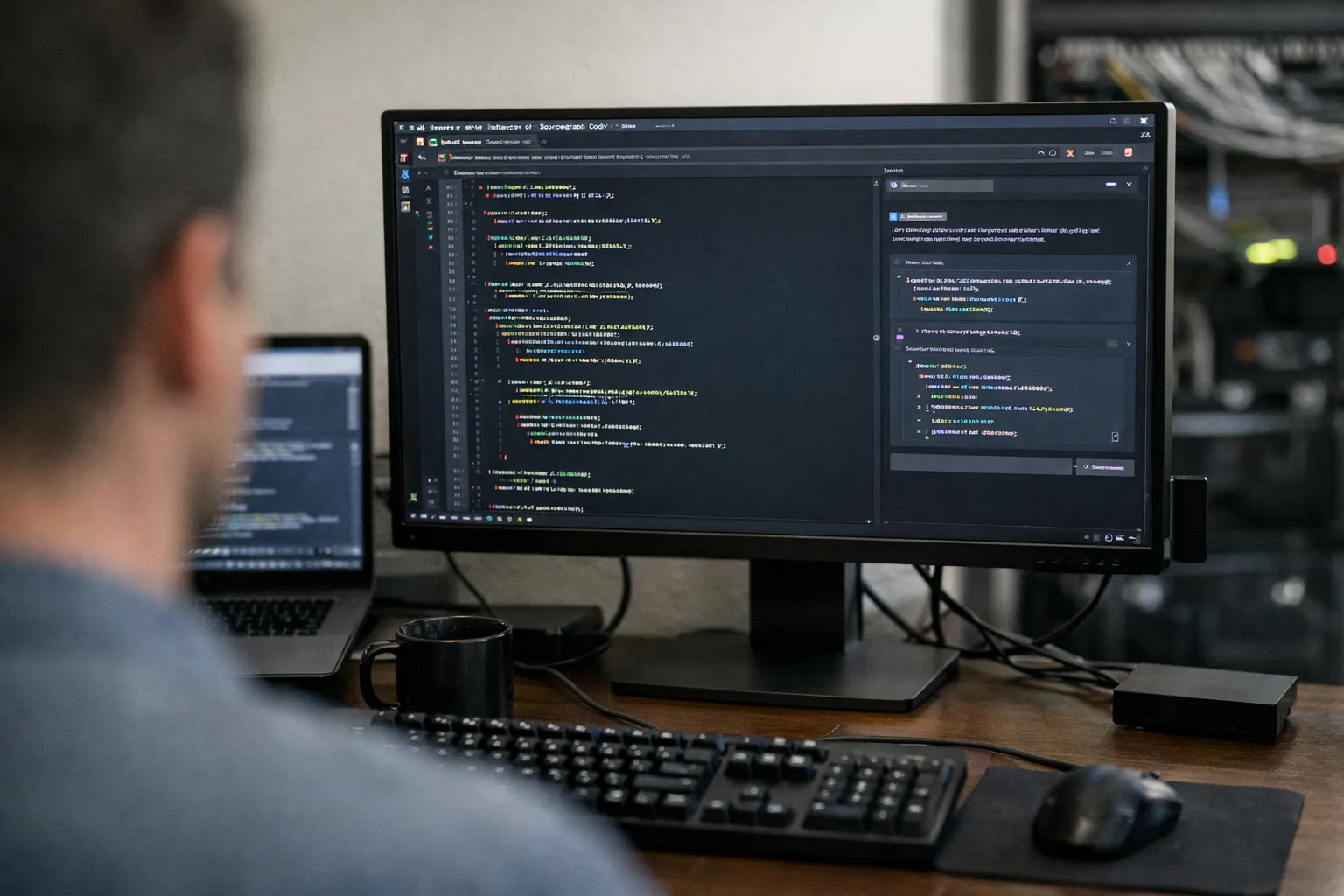
By Dr. Emily Torres — Health & Wellness Correspondent writing for AI Coding Tools Review
Overview
What we’re reviewing: Sourcegraph Cody (self‑hosted, October 2026). Cody remains Sourcegraph’s code‑aware AI assistant built on top of its global code search and retrieval infrastructure. This update focuses on recent operational and product developments for teams choosing on‑premises or private‑cloud deployments, and on practical guidance for 2026 production rollouts.
- Primary use: In‑IDE code assistance, cross‑repo reasoning, repository summarization, automated refactoring suggestions and PR drafting.
- Supported IDEs & platforms: VS Code, JetBrains IDEs, Neovim, Sourcegraph web UI, and REST/GraphQL APIs.
- Deployment options: Self‑hosted (Docker/Kubernetes) with private model routing; Sourcegraph Cloud remains an option for teams prioritizing low ops.
- Security features highlighted: SSO (SAML/OIDC), SCIM, RBAC, audit logs, network egress controls, DLP hooks and configurable model‑routing policies.
Background
Sourcegraph positions Cody for engineering organizations that require tight data governance combined with repo‑wide context. Since mid‑2026, adoption patterns have split: enterprises with strict IP/regulatory needs increasingly run Cody self‑hosted with private LLMs, while smaller teams lean on Sourcegraph Cloud or mixed routing to public endpoints to reduce costs.
Why it matters in Oct 2026: three practical shifts changed the calculus this year—(1) availability of more efficient quantized open‑weight LLMs that reduce GPU costs, (2) maturation of vector databases (Pinecone, Milvus, Weaviate and self‑hosted options) and incremental indexing pipelines, and (3) stronger regulatory focus (e.g., operationalizing the EU AI Act and U.S. AI guidance), which makes demonstrable data controls and audit trails essential.
Features Analysis
1. Retrieval‑augmented prompts and search accuracy
Cody’s core strength remains the retrieval pipeline: repository embeddings + code search give answers grounded in exact repository locations. In 2026, several improvements are notable:
- Incremental indexing options are more robust — teams can configure near‑real‑time updates for hot repos and nightly snapshots for archival code.
- Provenance surfaced in replies is now easier to expose in CI flows: responses link to code, blame, and PR history so reviewers can validate suggestions quickly.
Practical note: retrieval quality still depends on index cadence, chunking strategy and embedding dimensionality. Teams that profile tokenization and chunk sizes for their codebase see consistent gains in relevancy.
2. Model flexibility and private model routing
Sourcegraph continues to emphasize model routing. By October 2026 the typical self‑hosted architecture pairs Cody’s retrieval layer with one of three model classes:
- Private LLMs running in your VPC (quantized open models to reduce GPU footprint)
- Commercial hosted LLMs with controlled egress rules for non‑sensitive tasks
- Hybrid setups where short, high‑sensitivity prompts never leave the network
For many teams the rise of efficient quantized weights (8‑bit / 4‑bit inference) means private LLMs now approach hosted costs for steady state workloads — but peak loads still favor hosted endpoints unless you plan ample GPU headroom.
3. IDE and workflow integration
Cody’s IDE plugins continue to improve UX: inline provenance, "explain this function" panels, and PR template generators are more customizable. A common implementation is to gate model‑driven code changes behind feature flags and automated tests so human reviewers can accept suggested diffs with CI safety nets.
4. Security, compliance and auditability
Compliance features beyond SSO/RBAC are more prominent: audit trails for which model endpoint was used per query, and DLP callbacks to redact or block sensitive prompts. These controls help organizations prepare for regulatory audits under existing frameworks such as the EU AI Act and NIST AI risk management guidance.
5. Performance and scale
Operational lessons from larger adopters through 2026: initial indexing of mono‑repos remains I/O heavy; vector DB sizing and cache warming matter for first‑time queries; and inference latency aligns tightly with chosen model and quantization strategy. Plan for autoscaling model pods or hybrid bursts to hosted LLMs to reduce perceived latency during heavy developer hours.
Pros and Cons
Pros
- Data governance: Private model routing and egress controls allow demonstrable data locality for audits.
- Contextual intelligence: Cross‑repo reasoning and provenance links reduce time spent tracing call graphs and history.
- Configurability: Teams can tune retrieval cadence, chunking, and routing policies to balance cost vs. freshness.
- Improved cost efficiency: Recent quantization and open‑model tooling have reduced on‑prem GPU TCO for sustained workloads.
Cons
- Operational burden: Self‑hosting still requires SRE/ML ops skills for Kubernetes, model infra, and vector DB maintenance.
- Variable TCO: Costs hinge on chosen model strategy (private GPUs vs. hosted tokens) and index size.
- Ongoing tuning: Retrieval and prompt pipelines need continuous refinement as codebases evolve.
Pricing and Value
Public Cloud entry pricing (team tiers) remained in the same ballpark as mid‑2026 published ranges (about $9–$12 per user/month for basic teams), but Sourcegraph’s self‑hosted Enterprise licensing continues to be quote‑based and depends on seats, support SLAs, and deployment topology. Key drivers of total cost of ownership:
- LLM inference (GPU time) vs. hosted token billing
- Vector DB storage and snapshot retention policies
- Engineering time for deployment, index tuning, and observability
Value proposition: organizations that must demonstrate artifact locality and auditability often achieve better risk‑adjusted ROI with self‑hosted Cody. Teams without dedicated infra resources are likelier to prefer the Cloud or hybrid routing to begin with.
Who It's For
Ideal customers in Oct 2026:
- Enterprises with regulatory requirements or clear IP containment needs (finance, healthcare, regulated manufacturing)
- Large monorepo/microservice organizations that need cross‑repo reasoning and historical traceability
- Teams with ML/SRE capacity to operate model infra or a willingness to buy GPU‑time from cloud providers
Less suitable for:
- Small teams wanting out‑of‑the‑box zero‑ops assistance — Cloud or lightweight assistants may be faster to adopt
- Organizations unable to commit to continuous index and model pipeline maintenance
Alternatives
- Amazon CodeWhisperer: Deep AWS integration; attractive for AWS‑centric shops that accept hosted inference.
- Phind / Tabnine / Codeium: Lightweight assistants optimized for fast completions and lower operational complexity.
- Custom retrieval + open models: Build your own stack (embeddings + vector DB + private LLM) — flexible but requires substantial ML/infra effort.
Practical Recommendations (Oct 2026)
- Run a focused 30‑ to 60‑day pilot on representative cross‑repo tasks; capture relevancy, latency, developer time saved, and per‑query cost.
- Start with nightly reindexing plus incremental updates for active repos; measure retrieval drift and adjust chunking based on false positive rates.
- Use hybrid routing: reserve private LLMs for sensitive prompts and non‑sensitive or burst traffic for hosted LLMs to control costs.
- Define observability KPIs: query latency P95, cost per 1,000 queries, proportion of responses with provenance links, and a false‑positive rate for suggested code changes.
- Integrate audit logs with your SIEM and run red‑team prompt/ingress tests to validate egress and DLP controls before broad rollout.
Verdict
Sourcegraph Cody’s self‑hosted option remains the strongest choice for engineering organizations that must retain code locality, require cross‑repo intelligence, and can invest in infra and tuning. Improvements in efficient private models and vector DB tooling in 2026 have reduced operating costs, but operational complexity and variable TCO persist. Evaluate Cody with a time‑boxed pilot that measures both developer productivity gains and hard cost metrics; use hybrid routing to control expense while preserving sensitive data protections.
FAQ
Can I keep my code and prompts completely on‑premises with Cody?
Yes — in self‑hosted mode you can configure Cody to use private model endpoints, keep embeddings and indexes inside your network, and block outbound egress. Validate egress controls and DLP callbacks during your pilot and document them for audit purposes.
How much engineering effort is required to run Cody self‑hosted in 2026?
Expect several person‑weeks to set up a minimally viable deployment (Kubernetes, vector DB, model pods) and additional person‑weeks for tuning indexing, chunking and routing policies. Teams with existing ML infra can move faster; others should budget for ongoing tuning and observability work.
Will Cody replace human code review or developers?
No. Cody augments developer workflows by surfacing context, drafting code and PR text, and accelerating discovery. Human review remains essential for architecture, security, and business logic decisions. Treat Cody as a productivity multiplier, not a replacement.
How should I control costs for inference?
Use hybrid routing: private quantized models for steady, sensitive workloads and hosted LLMs for bursts or non‑sensitive tasks. Implement rate limits, cache common queries and monitor cost per 1,000 queries as a primary KPI.
What are common pilot pitfalls in late‑2026?
Pitfalls include under‑provisioned vector DBs, insufficient index cadence for active repos, not testing egress/DLP early, and failing to measure developer satisfaction alongside technical metrics. Define success criteria up front and include security stakeholders from day one.
Disclaimer: This article reflects product behavior, deployment patterns and best practices observed up to October 2026. Product features, pricing and regulatory guidance change—consult Sourcegraph documentation and your legal/compliance teams before deploying production systems.